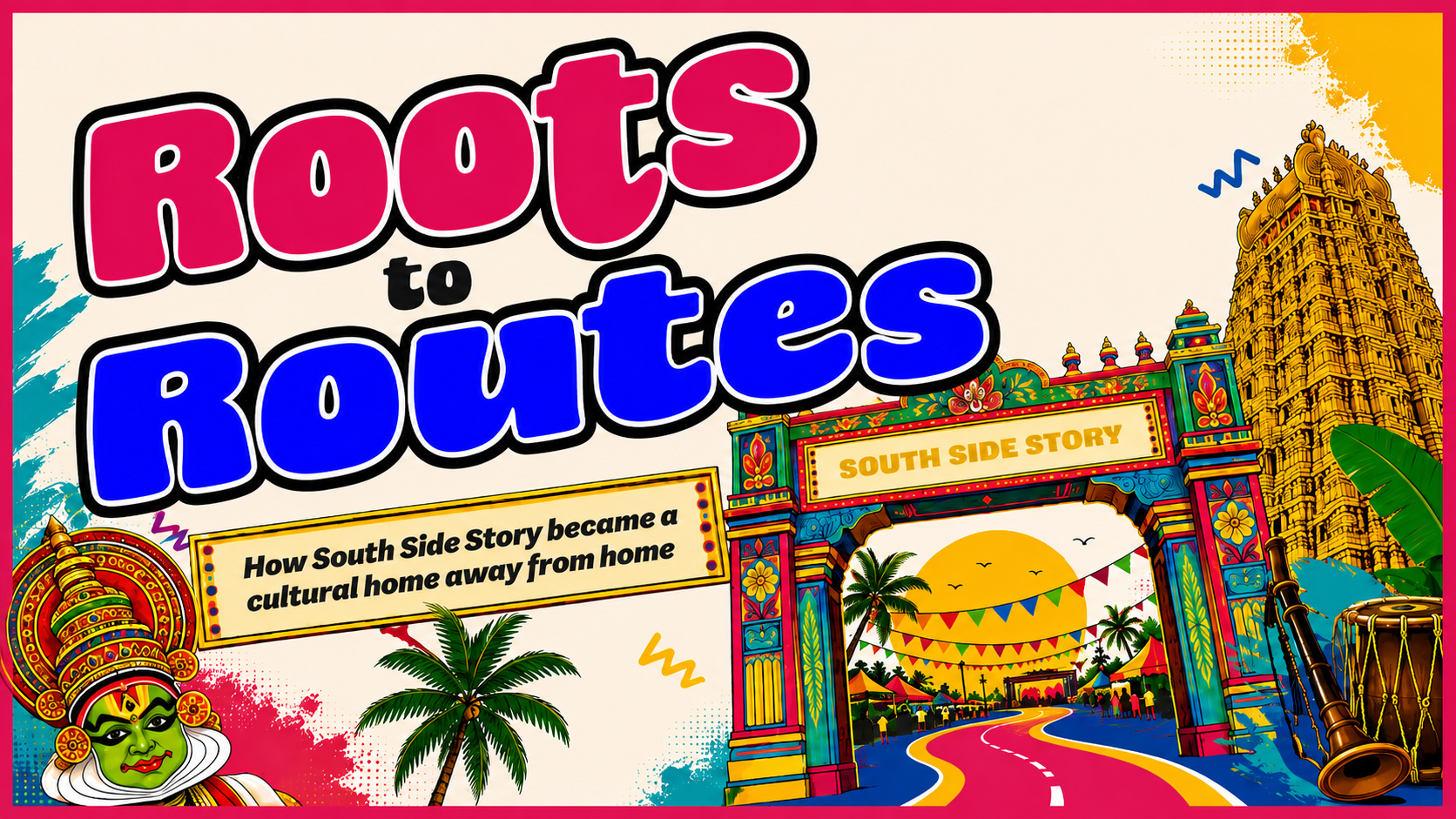
It started with kaapi and a conversation. Eight years later, it's become the most important annual reunion for South Indians living far from home, and now it's coming to Pune for the very first time. one afternoon in 2019, a small group of people at Red FM's Delhi office did what people at radio stations often do: they argued about music.Specifically, they argued about how barely any of the music they genuinely loved – the kind that made them feel something, that carried the particular weight of home, was making it onto the playlists of the city they lived in. There was Carnatic-tinged rock. There was the intricate percussion of Kerala folk. There was the unmistakable controlled chaos of Thaikkudam Bridge. None of it was getting through.
The meeting, if you could call it that, ran long.There were innumerable cups of filter coffee involved. By the end of it, the group had landed on an idea that felt obvious in the way that good ideas always do in retrospect: what if they simply brought the South to North? Not through a single performance or a one-off event, but through something that tried to hold the entire experience of a culture. Music, food, art, a sense of atmosphere. The whole thing.
That idea became South Side Story. The first edition, in September 2019, was modest in scale. Two bands: Agam, the Carnatic progressive rock group from Chennai who had spent years building a cult following without ever quite breaking through to mainstream attention; and Thaikkudam Bridge, the Kerala collective whose sound sits somewhere between rock, folk, and something that resists easy classification. The food was curated by Mahabelly in Delhi and South High in Mumbai, the two cities where the festival launched simultaneously. It sold out.
"The name South Side Story encompasses the whole South Indian experience in three words.
It echoes a sense of belonging to the ones whose roots lie down south, while creating an intrigue for those who wish to be a part of the culture."
Nisha Narayanan, Director and COO, Red FM
THE GAP THAT MADE THE FESTIVAL NECESSARY
To understand why South Side Story found an audience so quickly, you have to understand something about the texture of life for South Indians living in Delhi. The city is home to lakhs of people whose roots are in Tamil Nadu, Kerala, Karnataka, Andhra Pradesh, and Telangana – engineers, doctors, government officers, IT professionals, students who came for education and stayed for careers. Delhi is the capital. It is also, culturally, a thoroughly North Indian city. The dominant music is Punjabi. The dominant festivals are Diwali and Holi as celebrated in the North Indian idiom. The dominant food culture, for all its richness, does not really make space for a proper Sadhya or a Chettinad meal or a Kerala parotta.
This is not a complaint. It is simply geography. But it creates a particular kind of quiet hunger in people who have moved far from their home. A hunger not just for familiar food but for the specific feeling of being in a room where the music is your music. Where the references land. Where you are not, for once, the person trying to explain what a Pongal is.
Nisha Narayanan, the Director and COO of Red FM who has been the driving force behind the festival, has spoken about this openly. "We felt that there is a need for South Indian communities living in markets like Delhi and Mumbai to experience their culture," she said ahead of the fifth edition. "There are also many North Indians who want to experience the South. Our goal is to bring the South of India, primarily through music, to the North in whatever way we can. " What she was describing was not a niche ethnic-community event. She was describing cultural osmosis. A festival that would work in two directions at once.
There was also, she has noted elsewhere, a somewhat personal motivation: the belief that South Indian culture suffers from a specific kind of underestimation in North Indian cities. "There's a misconception that there's nothing 'cool' about the South," Narayanan said in one interview. "Often, the North holds certain stereotypes about the South, but through this festival, we aim to show that the South is just as cool and progressive as any other part of the country. " That framing – not defensive, not nostalgic, just cool and confident, turned out to be exactly right for the moment it launched in.
THE YEARS THAT BUILT IT
Then came 2020, and the world shut down. South Side Story, barely a year old, did what most events simply could not do: it kept going. The second edition went entirely online. There were cocktail masterclasses, cooking sessions, mixologist collabs. Sadhya meals were delivered to homes. Thaikkudam Bridge and Agam performed from wherever they could. It was a strange, makeshift thing, and it worked well enough to keep the community together through a year that tried very hard to scatter everyone.
The third edition, in 2021, was also digital. But by 2022, something had shifted. The festival returned to the ground, and it came back larger. Season four brought nine artists, up from two at the very beginning. The food spread was bigger. Thirty items on a banana leaf, reportedly the largest Sadhya offered at the event to that point. The crowd came in traditional attire. There were tears, reportedly, at more than a few points during the day. The thing had grown into itself.
By 2023, the fifth edition, South Side Story had expanded its frame beyond Kerala to embrace all five southern states. The line-up included Hanumankind, then on the edge of the international breakthrough that would come later, Tamil rapper Arivu performing with his band Ambasa, the genre-resistant Sean Roldan, and the reliable, extraordinary Thaikkudam Bridge. A life-sized rangoli. Gajra in attendees' hair. A full Kathakali performer as an Instagrammable centrepiece who was also just genuinely wonderful to watch. The festival had learned, by this point, how to be both deeply culturally specific and broadly accessible, which is a trick very few events manage.
The sixth edition in 2024 was described, by the people who ran it, as a "massive success", which is the kind of understatement that PR people use when something exceeds all projections. The 7th, in 2025, brought Shobana, the legendary Bharatanatyam dancer and actress, alongside The Raghu Dixit Project, Avial, T M Krishna, and more. It was held at KD Jadhav Wrestling Stadium in Delhi, a venue choice that felt appropriately grand for an event that had, by now, grown from an attendance of roughly 1,000 to 1,500 people in its first year to somewhere between 12,000 and 15,000 over two days.
WHAT THE NUMBERS DON'T SAY
There is the family that has made South Side Story their annual Onam. Parents in their sixties who were sceptical the first time and are now the ones who insist on going. Children who grew up in Delhi and for whom this festival is, genuinely, one of their primary touchpoints with the culture their parents came from. The Kerala engineer who has lived in Delhi for fifteen years and tells people that SSS is the one day a year he stops feeling like a transplant.
There is also the 35 to 40 % of the audience who come with no South Indian roots at all. The Delhiites who first tried a Sadhya at the festival and have been to authentic Kerala restaurants three times since. The college students who discovered Hanumankind at SSS before he was on international playlists. The people who came for the food, stayed for the music, and left with a richer idea of what India actually sounds like. By its fifth year, South Side Story had become something more interesting than a diaspora festival. It had become a cultural argument: that regional India is not lesser India, that the music coming out of Tamil Nadu and Kerala and Karnataka is sophisticated and contemporary and emotionally true.
THE PUNE CHAPTER
For seven years, the festival found its footing in Delhi and, for several editions, in Mumbai. It became, in both cities, a fixture. The kind of event that the community talks about in the weeks before and for months after.
Pune is different. It is a younger city by temperament, with a large student and IT population, a deep Marathi cultural identity, and a cosmopolitan curiosity that makes it receptive to cultural events from elsewhere in India. It also has a substantial South Indian community, people who came for engineering colleges and stayed for companies, who have been watching the Delhi crowd's annual photographs with a particular kind of envy.
South Side Story 2026 comes to Pune on August 22, for the first time. The expansion is not incidental. It reflects something the festival has always believed: that this story is not a Delhi story or a Mumbai story. It’s an Indian story, and India is large.
The 2026 line-up carries the weight of eight editions of trust and curation. Shobana returns. Thaikkudam Bridge, who have been here since the very beginning, returns. Karthik, whose voice has moved more Sadhya crowds than can be counted, is back. The Raghu Dixit Project, Masala Coffee, Sooraj Santhosh, Baby Jean, Aksomaniac, Avial – together they form the most comprehensive argument yet for the depth and range and contemporary relevance of South Indian music.
But the festival has always been more than its line-up. It is the banana leaf. It is the kaapi served in a small steel tumbler. It is the moment when the lights go down and the first notes of something familiar travel across a crowd of people who have been quietly missing a place, and you look around and realise that missing a place is something you can do together.
South Side Story 2026 comes to Delhi on 29 and 30 August, and to Pune for the first time on 22nd August. Tickets are at southsidestory.in. Come early for the Sadhya.
It started with kaapi and a conversation. Eight years later, it's become the most important annual reunion for South Indians living far from home, and now it's coming to Pune for the very first time.