
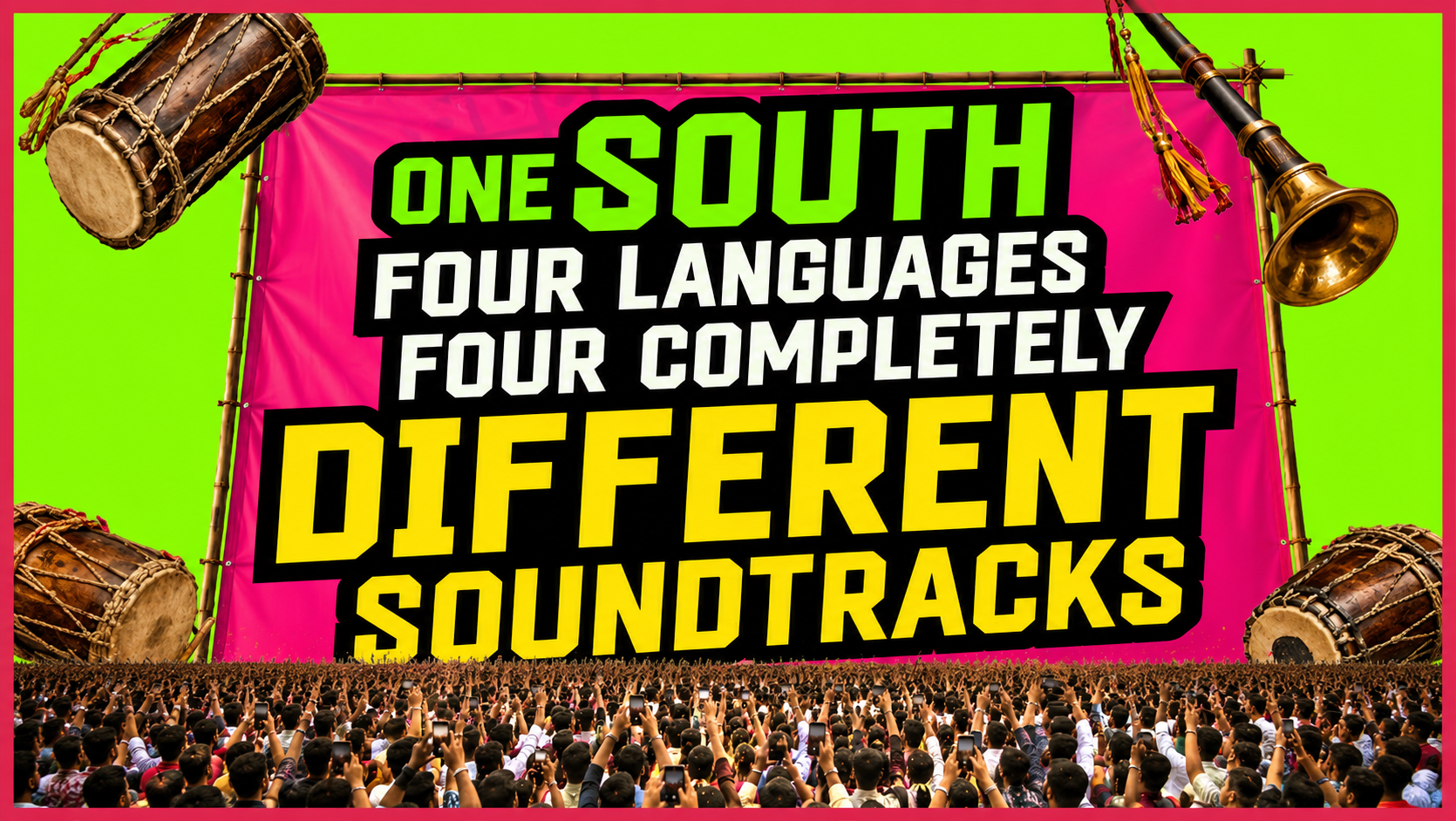
Before you dismiss South Indian music as a single category, consider this: Tamil, Telugu, Kannada, and Malayalam are as different from each other as Spanish is from Romanian. What they produce musically is four distinct worlds and this August, South Side Story puts all of them on one stage
Ask someone in Delhi to hum a South Indian song and there's a reasonable chance they'll do one of two things: produce a few notes from a film they half-remember, or admit they can't quite separate one from the other. This is understandable. From a distance, South Indian music can appear monolithic like temple bells, classical intensity, the particular sweetness of a melody you can't place. The problem with this picture is that it is wrong in almost every particular.
South India is not one musical tradition. It is four languages, four literary histories, four distinct relationships between rhythm and the divine, four different answers to the question of what a song is for. Tamil music, at its roots, is one of the oldest continuous musical traditions on the planet. Telugu cinema has just won an Oscar for a song whose energy owes something to ancient Kuchipudi footwork. Kannada folk poetry written by sixteenth-century mystic saints is being performed tonight at Glastonbury. And Malayalam hip-hop, barely a decade old as a genre, has cracked the Global Viral Charts with a track recorded by a twenty-year-old who quit engineering to make it.
South Side Story 2026, which arrives in Delhi on 29 and 30 August and in Pune for the very first time on 22nd August, is built on this insight: that the South is not one story. It is four languages of rhythm, and they sound nothing like each other.
TAMIL
The weight of the oldest continuous musical tradition in India
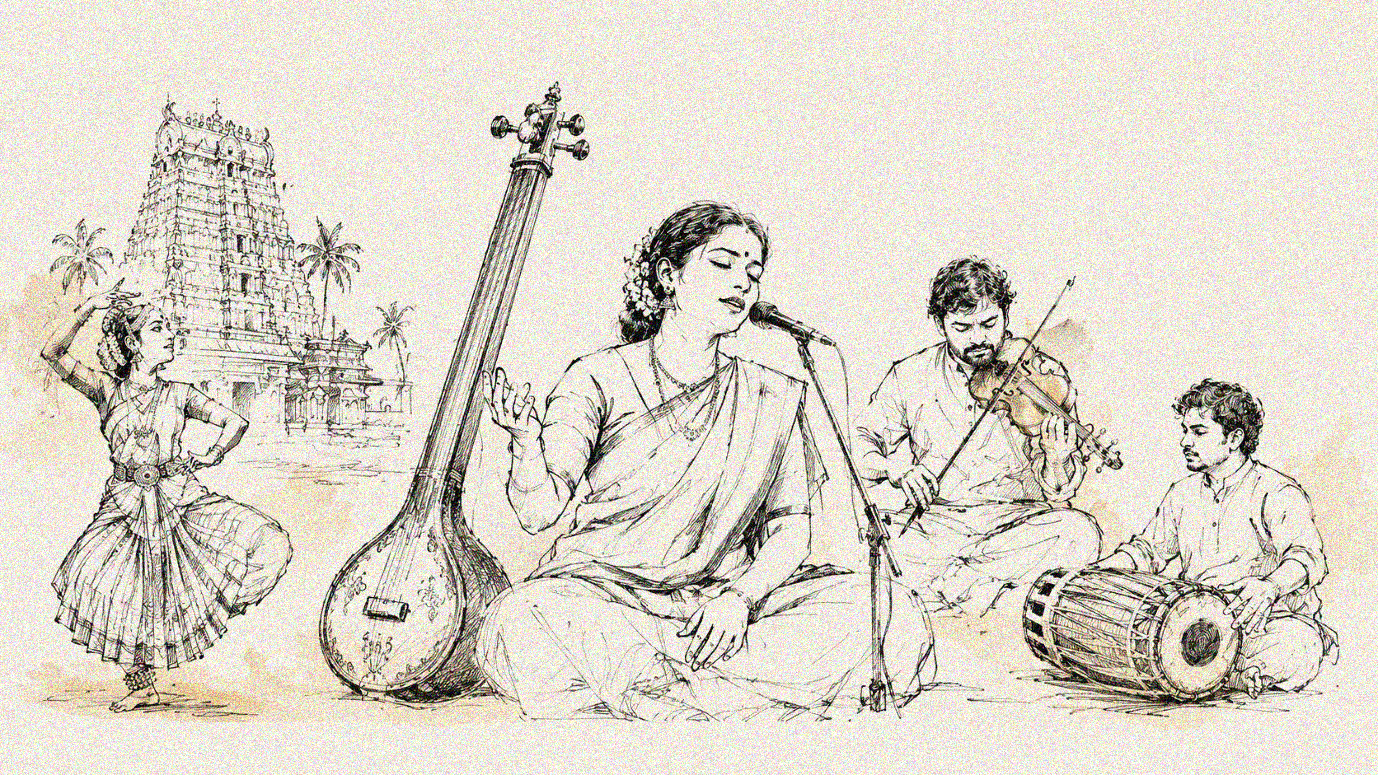
Tamil music begins somewhere around 3,000 years ago. What we now call Carnatic music, the classical system that governs South Indian music broadly, has its earliest documented ancestors in ancient Tamil texts like the Sangam-era poems and the Cilappatikaram. The Panns, ancient melodic frameworks described in those texts, predate the formal Carnatic raga system by centuries. When Saint Tyagaraja composed his Kritis in the eighteenth century, when Muthuswami Dikshitar brought his intricate, Sanskrit-soaked compositions into the tradition, they were building on a foundation that Tamil culture had been laying since before most of the world's major civilisations had decided what music was for.
The defining quality of Carnatic Tamil music is its relationship with rhythm. Konnakol, the practice of vocalising percussion syllables with the voice, is among the most intellectually demanding performance arts in any musical tradition anywhere. Performers speak intricate rhythmic patterns – ta ka dhi mi, ta ki ta, thom while simultaneously tracking the tala cycle with their hands, producing a kind of live mathematical argument about time. John McLaughlin, the British jazz guitarist, spent years studying it. Zakir Hussain has called it among the most sophisticated rhythmic languages he has encountered.
Then there is the other Tamil music: the one that has given the world A.R. Rahman, that produces Anirudh Ravichander's genre-dissolving soundtracks, that gave us Arivu performing Tamil hip-hop at SSS Delhi a few years ago to a crowd that barely understood the words and was completely absorbed anyway. Tamil film music is the bridge, the place where Carnatic scales meet trap beats, where a centuries-old raga becomes the foundation of something you would hear in a club in London.
TELEGU
The cinematic powerhouse that won an Oscar, and isn't done
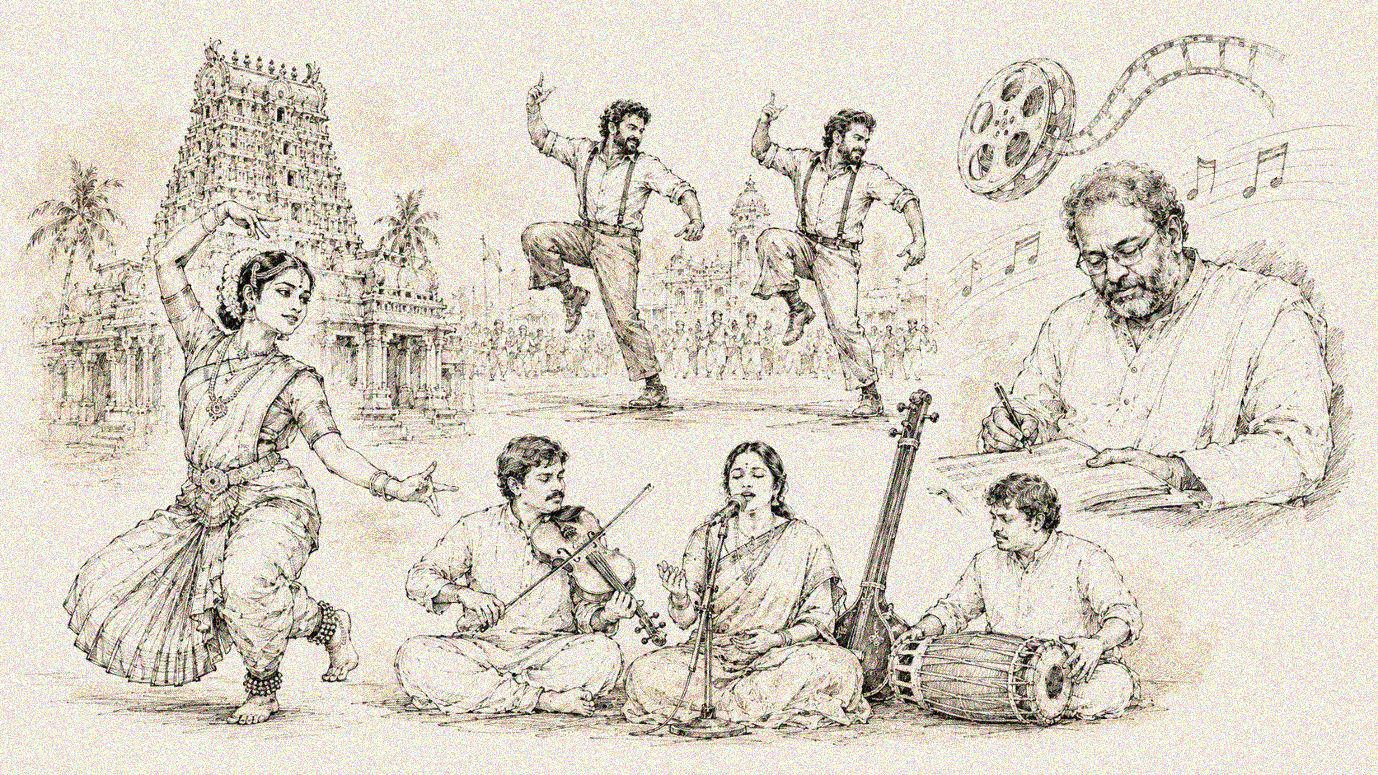
Telugu is the language with the largest number of speakers in South India. It has also produced the loudest argument that South Indian culture deserves global attention.
In 2023, a Telugu song won the Academy Award for Best Original Song. Naatu Naatu, from S.S. Rajamouli's epic RRR, composed by M.M. Keeravani, performed at the Oscars by Rahul Sipligunj and Kaala Bhairava, was the first Indian film song ever to receive this recognition. The song's energy, the percussive athleticism of the choreography draws directly from Telugu's folk tradition. Kuchipudi, the classical dance form that is Andhra Pradesh's oldest gift to Indian performing arts, is built on fast, precise footwork and deeply rhythmic compositions. Jr. NTR, who dances Naatu Naatu in the film, spent 13 years training in Kuchipudi. The Oscar-winning song is, in a sense, a three-thousand-year-old tradition arriving on the biggest stage in the world.
Telugu music's particular quality is scale. The film industry produces songs of enormous ambition, orchestral arrangements, high-production-value spectacle, music designed to fill a stadium and a personal earphone simultaneously. Composers like Devi Sri Prasad, whose work is irresistible even when you cannot understand the words, have developed a sound that is both completely culturally specific and somehow universally affecting.
At the same time, Telugu has its intimate traditions too. The lyrical weight of classical Telugu poetry described by scholars as one of the sweetest of the Dravidian languages, gives its slower compositions a quality of feeling that is genuinely distinct. There is a reason Carnatic compositions in Telugu are performed across all South Indian states. The language bends easily toward devotion and longing.
KANNADA
Ancient mystic poets and a Glastonbury stage, sometimes in the same show
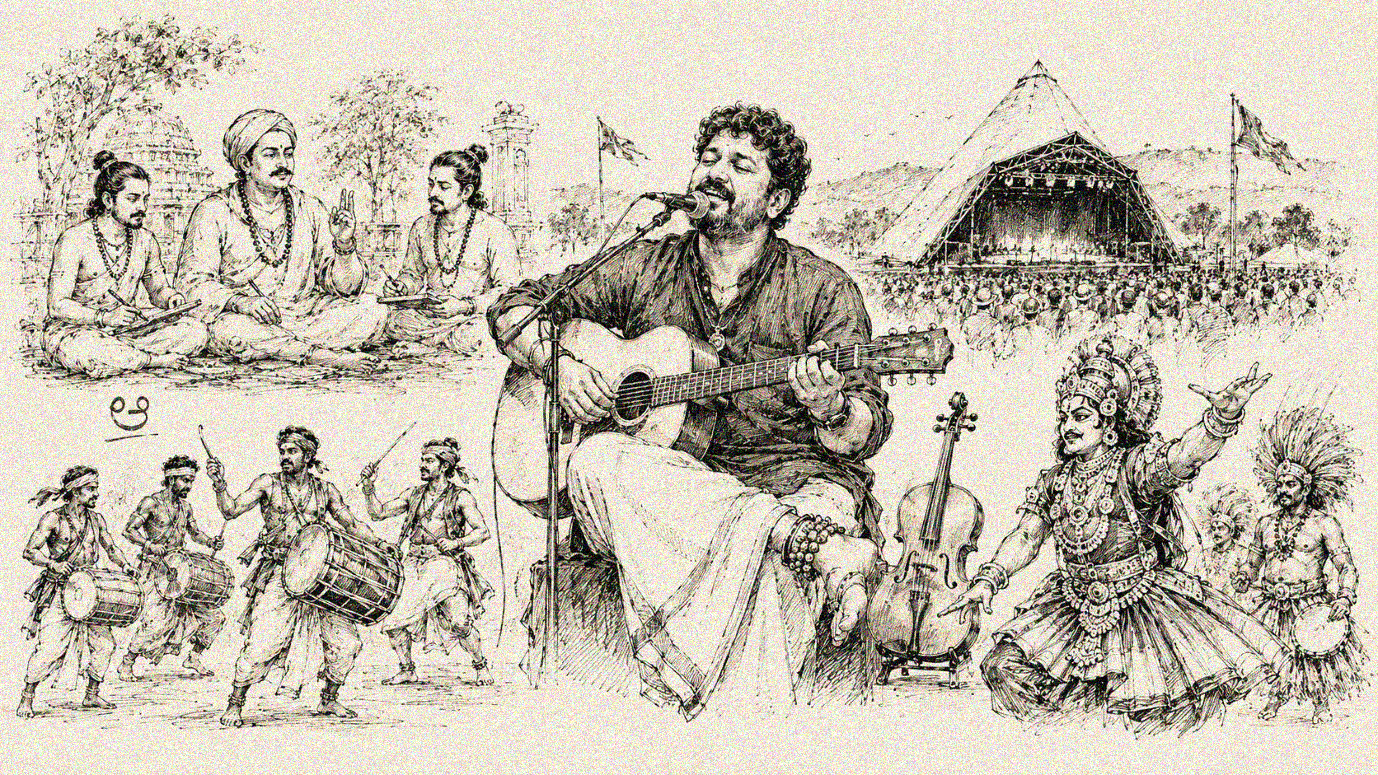
When Raghu Dixit walked out on the stage at Glastonbury in a lungi and ghungroo, with a Carnatic violin on one side and an electric guitar on the other. He was doing something that the Indian music industry had largely decided was commercially unviable: he was singing in Kannada, in folk melodies, about things that mattered to him.
Dixit's own biography describes what he was doing simply: taking ancient Kannada poetry and presenting it around the world with a contemporary global sound. The Kannada poets he draws on the Vachana poets of the Virashaiva tradition, saints and mystics like Basavanna who wrote in a radical, direct style in the twelfth century were themselves anti-establishment figures. They rejected caste hierarchy, rejected elaborate ritual, and put their philosophy into short, sharp, emotionally direct poems. Dixit set these to guitars and violins and played them in Sydney and Abu Dhabi and, yes, Glastonbury. The Guardian called him the pioneer of folk-rock fusion.
What is striking about Kannada folk music, in its broader tradition, is its earthiness. The Yakshagana theatre tradition, the Dollu Kunitha drum performances, the Veeragase devotional art all of it is grounded in the physical, in the land, in the community. Kannada folk is not trying to transcend anything. It is trying to be entirely present in the world as it is. Raghu Dixit carries that quality into every room he performs in, which is why people who have no connection to Karnataka leave his shows feeling that they have visited something real.
"Every 200 kilometres in this country, languages change, the dialects change and the food changes. My music is unique because it is sung in a vernacular tongue, it adds mystery." – Raghu Dixit,
MALAYALAM
From the temple steps to the Global Viral Charts, in one generation
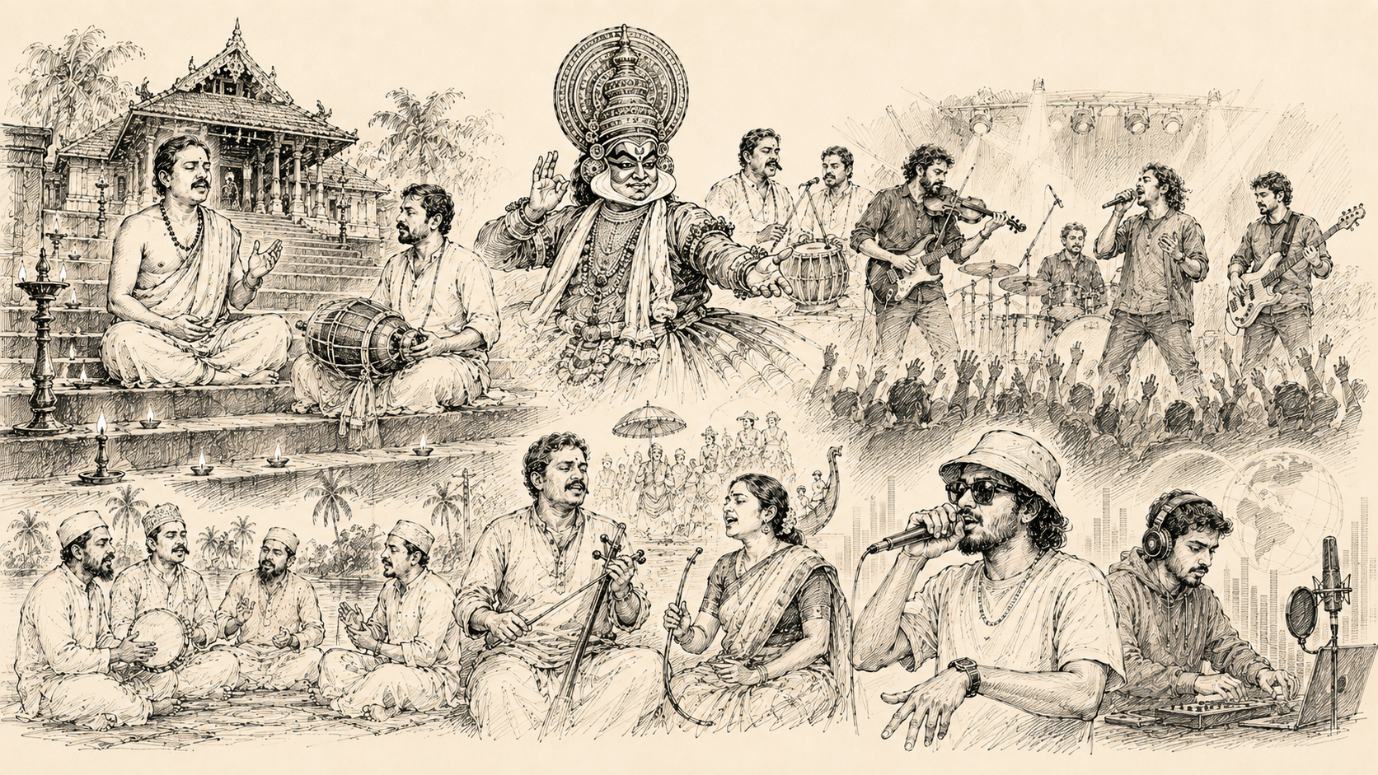
Kerala's musical tradition begins in temples, specifically on the steps, the sopanam, leading to the sanctum sanctorum. Sopana Sangeetham, the classical temple singing tradition of Kerala, is among the most meditative musical forms in South India. Sung in Sanskrit, Malayalam, or Manipravalam (a blend of both), accompanied by the edakka drum, it moves at the pace of a slow tide coming in. It is music for approach, for the gradual narrowing of the gap between ordinary experience and the divine. The style of tonal modulation, one scholar writes, is like the rise and fall of sea waves in a rhythmic and beautiful manner.
Kathakali music, which grew out of the Sopana tradition, has its own intensity – dramatic, rich with improvisation, designed to carry the weight of gods and demons and their confrontations. And then there is the broad folk tradition: Mappila Pattu, the devotional music of Kerala's Muslim community, with its Persian and Hindustani influences woven into Malayalam verse; the Onavillu Pattu sung during Onam; the Vadakkan Pattu ballads of the northern districts.
What happened to this tradition in the last decade is one of the more interesting cultural stories in India? Thaikkudam Bridge, the fifteen-member collective from Kochi formed in 2013, took Kerala's folk and classical foundations and built a rock architecture on top of them that nobody had quite attempted before. Their own description of their sound is precise: a soundscape built upon elements of folk and classical sounds of India, interspersed with layers of progressive, pop, ambient and electronic textures. No two songs sound the same, says founder Govind Vasantha. They treat every song differently. The band has performed in twenty-five countries. Fish Rock, their breakthrough, went globally viral before viral was quite the word for it.
And then the hip-hop generation arrived. The Malayalam rap scene, which barely existed before 2018, has in seven years become one of the most creative music communities in India. Hanumankind, who performed at SSS Delhi in 2023, later crossed into international playlists. Baby Jean, Dabzee, Fejo, Vedan; the scene has depth. And now Aksomaniac, whose track Amsham recently reached number four on the Global Viral Charts. Aksomaniac describes his own sound as Malayalam R&B, and he is precise about the importance of language to what he does. He has spoken about actively studying Malayalam more deeply because every language carries emotions differently, and he wants to understand how Malayalam does it.
What this means, on the ground, is that the Malayalam musical tradition has moved from temple steps to global streaming charts in the span of a single generation, without losing its essential character: that quality of feeling that comes from a place with very old roots and very clear water.
WHY THIS MATTERS ON ONE STAGE
South Side Story has, from its earliest editions, understood something that the Indian music industry has sometimes forgotten: that regional specificity is not a limitation. It is the thing. When Thaikkudam Bridge plays their set, they are not performing something called South Indian music in a general sense. They are performing a very specific cultural argument about what happens when Kerala's folk tradition meets rock. When The Raghu Dixit Project takes the stage, in lungis and ghungroo, with lyrics drawn from twelfth-century Kannada saints, they are making a statement that has nothing to do with commercial calculation.
What South Side Story does is put these four worlds in proximity. Tamil Carnatic discipline. Telugu cinematic scale. Kannada folk rootedness. Malayalam's remarkable range from the ancient to the contemporary. They do not dissolve into each other. They do not merge into something called South Indian fusion. They sit next to each other, distinct and proud, and the audience moves between them.
The 2026 lineup reflects this. Shobana carries the weight of classical dance tradition. Thaikkudam Bridge brings the Kochi collective. Karthik, whose voice has appeared in films across four South Indian languages, is a kind of living proof that these traditions can speak to each other without losing themselves. The Raghu Dixit Project arrives with ancient Kannada verse and global intentions. Aksomaniac represents where Malayalam music is going. Masala Coffee represent where it has always been warm and certain and true to itself.
The point is not that these artists represent their states or their traditions in any official capacity. The point is that they grew from specific soils, and those soils are different, and that difference is audible in every note they play.
You do not need to know the history of Sopana Sangeetham to feel the difference when Thaikkudam Bridge plays. You do not need to have studied Vachana poetry to understand what Raghu Dixit is doing with his lungi and his ghungroo and his electric guitar. You just need to pay attention. The music will tell you everything.